Publications
2026
- ICLR
 Jeongyong Yang*, Seunghwan Jang*, and SooJean HanIn The Fourteenth International Conference on Learning Representations (ICLR), Apr. 2026.(to appear).
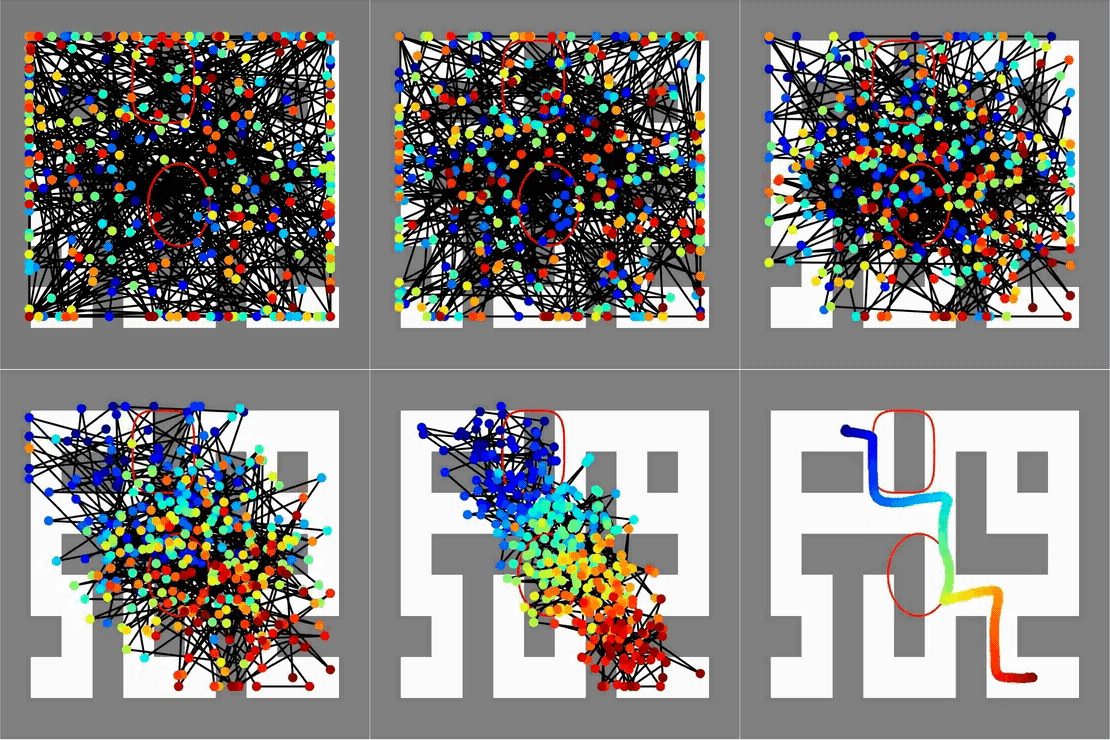
Generative planners based on Flow Matching (FM) produce high-quality paths in a single or a few ODE steps, but their sampling dynamics offer no formal safety guarantees and can yield incomplete paths near constraints. We present SafeFlowMatcher, a planning framework that couples FM with control barrier functions (CBFs) to achieve both real-time efficiency and certified safety. SafeFlowMatcher uses a two-phase prediction–correction (PC) integrator: (i) a prediction phase integrates the learned FM once (or a few steps) to obtain a candidate path without intervention; (ii) a correction phase refines this path with a vanishing time-scaled vector field and a CBF-based quadratic program that minimally perturbs the vector field. We prove a barrier certificate for the resulting flow system, establishing forward invariance of a robust safe set and finite-time convergence to the safe set. In addition, by enforcing safety only on the executed path—rather than all intermediate latent paths—SafeFlowMatcher avoids distributional drift and mitigates local trap problems. Moreover, SafeFlowMatcher attains faster, smoother, and safer paths than diffusion- and FM-based baselines on maze navigation and locomotion. Extensive ablations corroborate the contributions of the PC integrator and the barrier certificate.
- A Gaussian Process Perspective on Overgeneralization in Random Network DistillationMinseok Jeong*, Yechan Lee*, Hyewon Choi, Jeongyong Yang, and 1 more authorJan. 2026. (submitted to ICML 2026)
Random Network Distillation (RND) is widely used in reinforcement learning (RL) as a scalable novelty signal that quantitatively measures familiarity. However, RND is prone to overgeneralization, in which novel inputs may be incorrectly assigned low novelty scores. To address this, we analyze RND through a Gaussian process framework and show that reliable novelty discrimination depends on the spectral properties of the kernel induced by the target network. Motivated by our analyses, we propose RFF-RND, a lightweight variant of RND that incorporates random Fourier features (RFFs) in the target network to enable explicit control over the kernel spectrum. Our theoretical results show that RFF-RND improves discrimination even for samples lying near the boundary of the data manifold. We compare RFF-RND with baseline methods on the D4RL offline benchmark and Atari online benchmarks.
2025
- KSAS
 Random Fourier Features Lifted Physics-Informed Koopman NetworkIn Proceedings of the Korean Society for Aeronautical & Space Sciences (KSAS), Nov. 2025.(in Korean).
Recent advances in Koopman learning have been largely dominated by model-free approaches. However, the increasing availability of simulators and known vector fields has highlighted the potential of model-based environments. In this study, a novel method termed Random Fourier Feature–Physics-Informed Koopman Network (RFF-PIKN) is proposed, which combines Random Fourier Features (RFF) with a Physics-Informed Koopman Network structure. The proposed approach fixes the RFFs and trains only the linear transformation matrix and decoder, thereby achieving a significant reduction in the number of parameters and computational cost while maintaining high predictive accuracy. To ensure fair comparison, the same RFF and physics-informed learning scheme are applied to Extended Dynamic Mode Decomposition (EDMD) and Learning Koopman Invariant Subspace (LKIS) methods. Experimental results on various benchmark systems demonstrate that RFF-PIKN consistently outperforms existing methods in terms of training stability and long-term prediction accuracy. These results confirm that, in model-based settings, the PIKN architecture provides a fundamentally more efficient framework than conventional loss-driven approaches.
- Preprint
 Jeongyong Yang*, KwangBin Lee*, and SooJean HanarXiv preprint, Jul. 2025.
Real-time planning among many uncertain, dynamic obstacles is challenging because predicting every agent with high fidelity is both unnecessary and computationally expensive. We present Heterogeneous Predictor-based Risk-Aware Planning (H-PRAP), a framework that allocates prediction effort to where it matters. H-PRAP introduces the Probability-based Collision Risk Index (P-CRI), a closed-form, horizon-level collision index obtained by calibrating a Gaussian surrogate with conformal prediction. P-CRI drives a router that assigns high-risk obstacles to accurate but expensive predictors and low-risk obstacles to lightweight predictors, while preserving distribution-free coverage across heterogeneous predictors through conformal prediction. The selected predictions and their conformal radii are embedded in a chance-constrained model predictive control (MPC) problem, yielding receding-horizon policies with explicit safety margins. We analyze the safety-efficiency trade-off under a prediction compute budget: allocating more to low-fidelity predictions reduces residual risk from dropped obstacles, but at the same time induces larger conformal radii, degrades trajectory efficiency, and shrinks MPC feasibility. Extensive numerical simulations in dense, uncertain environments validate that H-PRAP attains the best balance between trajectory success rate (i.e., no collisions) and time to reach the goal (i.e., trajectory efficiency) compared to single-prediction architectures.
- KRoC
 Curvature- and Energy-based Trajectory Optimization in Unstructured EnvironmentsJeongyong Yang, Hojin Ju, and SooJean HanIn Proceedings of the Korea Robotics Society Annual Conference (KRoC), Feb. 2025.(in Korean).
Safe and efficient path planning is crucial for autonomous driving systems. In this paper, we propose a trajectory optimization algorithm for unstructured environments that minimizes both curvature and energy while achieving a near-time-optimal path. To improve efficiency of the optimization process, we employ path velocity decomposition and reformulate the complex optimization problem with the agent’s dynamic constraints into a quadratic programming (QP) problem, considering the agent as a point of mass. Previous curvature-based algorithms were primarily designed for racing scenarios, limited to static bounded tracks. In contrast, our approach extends their applicability to complex open environments with obstacles, enabling safe and efficient navigation through the use of a boundary tube constraint. Furthermore, we introduce several techniques to adapt the algorithm to unstructured environments, such as adaptive path spacing to enhance computational efficiency by reducing the dimension of the QP problem. Additional methods, including boundary tube correction and decaying curvature bound, ensure more feasible and stable solutions for the algorithm. The proposed algorithm was implemented in ROS Gazebo and successfully tested on a four-wheel drive robot. Results demonstrate that the proposed algorithm generates safe, smooth and time efficient paths, showing improved performance compared to B-spline and the original curvature-based optimization method.